

This post is also available in:
 Español (Spanish)
ABOUT THE EXHIBITION
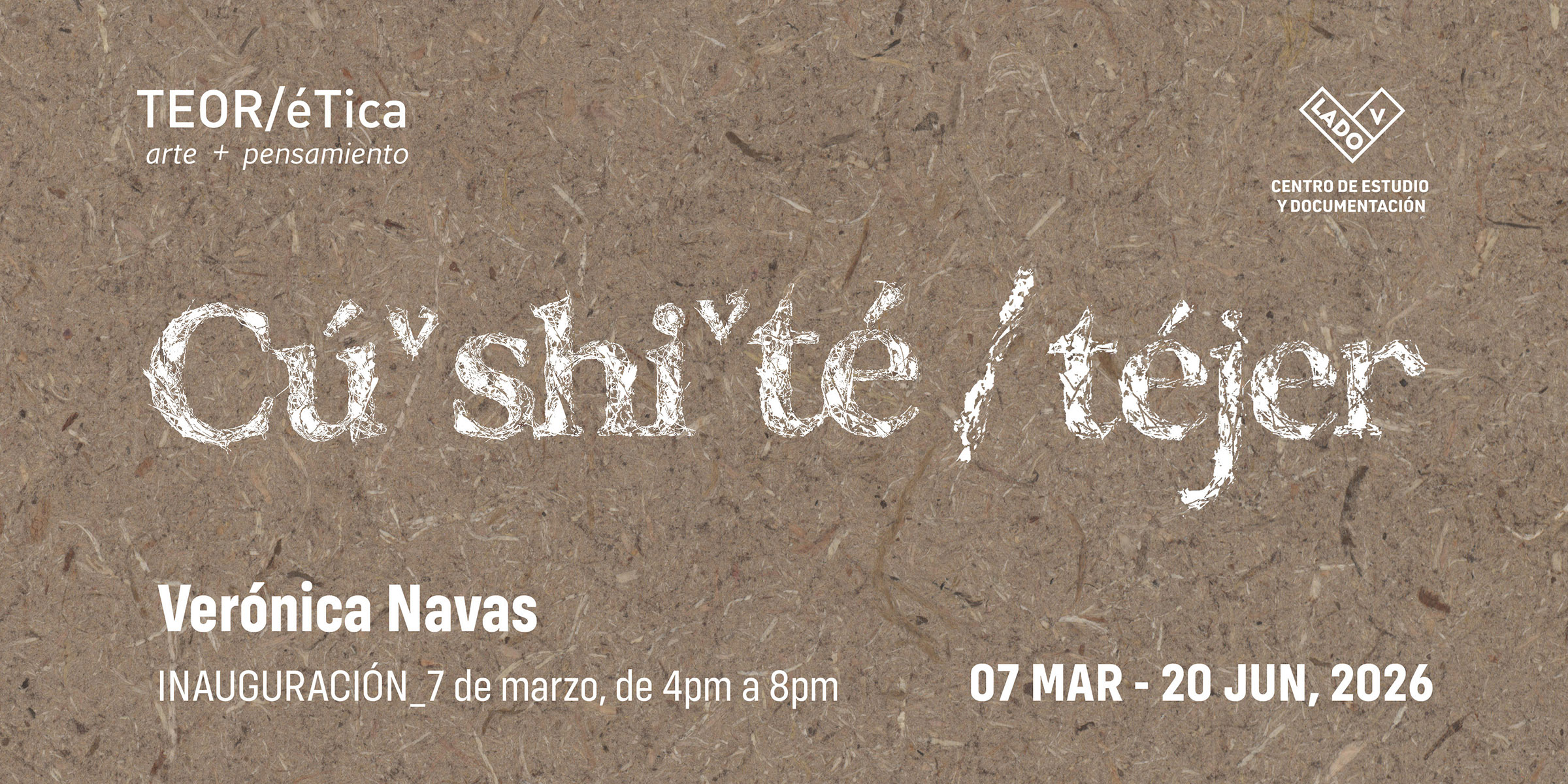
Verónica Navas: Cúˇshi téˇ / Tejer
EXHIBITION DATES: March 7 to June 20, 2026
CURATOR: Emiliano Valdés
VENUES: TEOR/éTica.
De ré, poderíamos dizer que no princípio era na folha.
Ailton Krenak
Verónica Navas is a multidisciplinary artist and herbalist with Boruca and Térraba cultural roots whose practice arises from dialogues with nature that re-signify questions about the body, identity, and ways of inhabiting different territories. Her projects—often composed of multiple pieces, sketches, and archives—explore themes such as identity politics and colonial wounds, as well as their counterpart: the right to heal and herbal medicine. Through mediums ranging from drawing and video to planting and caring for plants, she articulates investigative and speculative discourses on the processes inherent to her cultural experience and on the reality of indigenous peoples in an aspirational white country.
The Boruca people are an indigenous group from the Costa Rican South Pacific area, known for the continuity of their cultural and artisanal practices, as well as for a history marked by processes of displacement and internal colonialism. Their language, falsely considered extinct, is currently undergoing a process of revitalization thanks to speakers of the language and linguists both in and outside the community; thus, facing a struggle that runs through the artist’s reflections on memory, transmission, and absence. It is no coincidence that the exhibition is named in two languages, in an attempt to point out—rather than recover—an understanding of the world repressed by colonial processes.
In Verónica Navas’ work, weaving is a vital operation: an action that links body, territory, and memory, allowing us to think of form as the result of slow, relational, and deeply incarnated processes. Cúˇshi téˇ, which in Di Tegat (our way of speaking in Boruca language) refers to the act of weaving, names a practice that precedes the image and unfolds as a form of knowledge and union between worlds. However, Cúˇshi téˇ does not translate literally as “weaving,” but rather refers to a series of cumulative actions—sowing, spinning, caring—which, taken together, could be understood as the art of weaving.
This clarification not only does justice to the Boruca language, but also provides fundamental keys to understand Navas’s work process. The pieces in the exhibition focus on specific aspects of the weave and creation that, taken together, produce broader and more holistic discourses about their place in the world.
The exhibition brings together installations, drawings, objects, photographic records, and videos made between 2018 and 2025, articulated around a precise material vocabulary: jute, cotton, cabuya, charcoal, kraft paper, and, insistently, the jícara (calabash fruit) . This fruit appears as a container, body, seed, and sensitive surface; as a structure capable of housing symbolism, memories, and projections, but also as a figure of resistance and propagation.
In early works such as Dinámica de reconocimiento, La forma del sol, and Mujer semilla, the jícara acts as a threshold between the artist and the world, between the organic and the symbolic, between what protects and what germinates. The artist understands the jícara as a master tree, as a spirit with whom she dialogues and from whom she learns. “I am a student of Hun-Hunahpú,” a central figure in Quiché Mayan mythology whose head was placed on a tree, claims the artist.
Alongside the jícara, weaving—understood as an action—constitutes the second line of exploration in this exhibition and manifests itself both in suspended installations—Nidos, Constelar—and in the graphic gesture of drawing and sketching. Ties, cords, and knots appear as forms of support, but also as marks of dependence, care, and vulnerability.
In Cordón umbilical, Amarres and Trasplantarse, the body is presented as a territory in constant shifting—just as the Térraba culture has been—crossed by inherited memories and processes of adaptation, as well as the border with Panama, whose territory is home to the Naso Teribe, ancestors of the Térraba.
The ritual dimension traverses the exhibition without imposing itself as a closed narrative. In Ritual de epitelización, the video, drawings, and jícara form a space where skin—both individual and collective—is reconstituted. It is not only about healing, but also about covering again, generating layers that allow us to continue. In this sense, weaving is also a practice of survival.
Along these lines, the large-format drawing Nacimiento, mi madre parió una jícara places the origin not as a fixed point, but as a transmitted narrative, as an image that is inherited and transformed. The work condenses many of the questions that run through the exhibition: being, growing, and becoming a jícara; merging with memory and nature, but also returning to them. In her quest to understand territorial and identity processes, Navas reaffirms her being-jícara, sustained by fabrics and fibers that tie her to her roots. The seed—as the text that accompanies the work states—contains all the answers and all the possibilities.
Cúˇshi téˇ/ Tejer is a journey through ideas, processes, and projects that look both inward, at the artist, and outward, at the collective memory of the communities. It is also an invitation to listen to that unwritten knowledge: that of hands, bodies, and materials that, when woven together, sustain life. Her work invites us to understand that the destruction of a territory leads to an atrophy of perception and that the exercise of returning to plants with the body is a remedy for the internal colonialism implemented by state identity dynamics. A recognition of the seed, the leaf, and the fruit as moments of the same journey through the world.
Emiliano Valdés, Curator
INFORMATION
Verónica Navas González (b. 1995, San José, Costa Rica)
Multidisciplinary visual artist and herbalist whose practice arises from dialogues with nature that reframe questions about the body, identity, and ways of inhabiting different territories. She explores themes such as identity politics, colonial wounds, and herbal medicine through media ranging from drawing and video to planting and caring for plants, with which she constructs archives, maps, and installations. She has participated in international residencies in countries such as Panama, Colombia, Guatemala, and Jordan, and her work has been exhibited in spaces such as the Costa Rican Art Museum, the Spanish Cultural Center in Costa Rica, the Costa Rican Museum of Contemporary Art and Design, the MMAG Foundation in Jordan, and the 23rd Paiz Art Biennial in Guatemala, among others. She has been recognized with awards such as El Flotador from TEOR/éTica and the Prince Claus Seed Award.
Emiliano Valdés (1980, Guatemala).
Guatemalan curator based in Guatemala City. He currently serves as an advisor to the government on matters related to arts, design, and craftsmanship. Until 2024, he served as chief curator of the Museum of Modern Art in Medellín, Colombia, where over the last decade he developed a program that multiplied the voices resonating in the museum and positioned it internationally. Valdés is also an advisor to Kadist (France–USA) and sits on the boards of various organizations such as the Cervieri Monsuárez Foundation (Uruguay) and ArtBo (Colombia). He is currently researching the intersection between artistic practices and artisanal processes.
This post is also available in:
Español (Spanish)